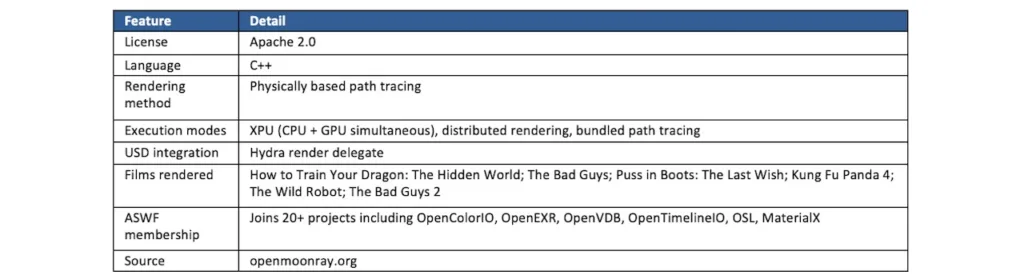
DreamWorks Animation has donated MoonRay, its production path-tracing renderer, to the Academy Software Foundation. MoonRay has rendered every DreamWorks feature film since 2019—from How to Train Your Dragon: The Hidden World through The Wild Robot and The Bad Guys 2. Built from scratch with no legacy code, it supports distributed rendering, XPU mode across CPU and GPU, bundled path tracing, and a USD Hydra delegate. Under Apache 2.0, it’s now free for any studio, developer, or student to use and extend. Creates interesting competition to RenderMan and Blender.
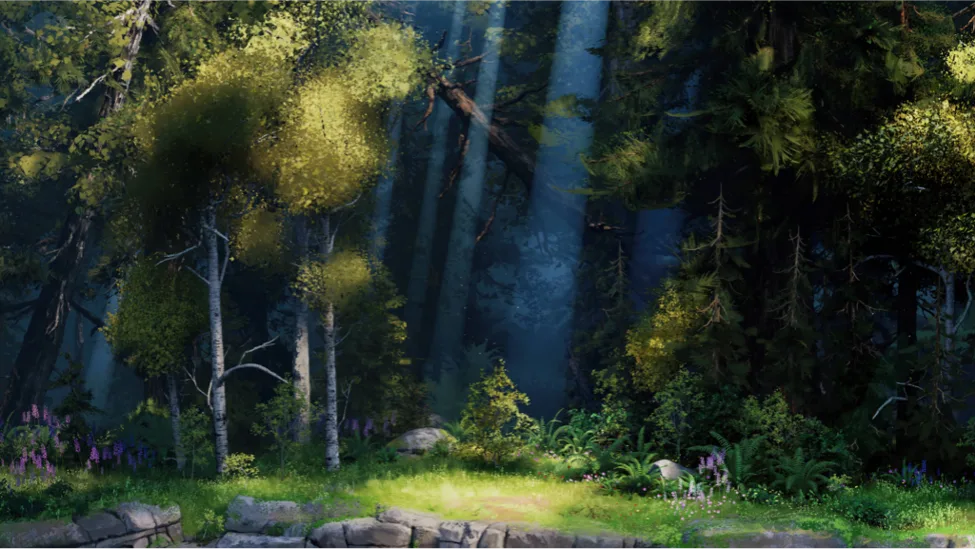
DreamWorks Animation built MoonRay to render feature films. Six of them—How to Train Your Dragon: The Hidden World, The Bad Guys, Puss in Boots: The Last Wish, Kung Fu Panda 4, The Wild Robot, and The Bad Guys 2—came out of this renderer since 2019. Now DreamWorks has contributed MoonRay to the Academy Software Foundation, making it available under the Apache 2.0 license to any studio, developer, or student who wants it.
The move puts MoonRay alongside a group of production-grade open-source tools that the VFX and animation industry already depends on—OpenColorIO, OpenEXR, OpenVDB, OpenTimelineIO, Open Shading Language, and MaterialX. The Academy Software Foundation hosts all of them, providing governance, infrastructure, and a neutral home where competing studios can collaborate on shared technology without ceding competitive ground to each other.
What MoonRay Is
MoonRay is a physically based path tracer. It models light the way light actually behaves—tracing rays from a camera through a scene, calculating reflections, refractions, and absorption at each surface intersection, while accumulating samples until the image converges. That approach produces the photorealistic imagery audiences expect from modern animated features, as well as stylized looks that deviate deliberately from physical accuracy.
DreamWorks built MoonRay without inheriting legacy code from prior rendering systems. That clean-sheet architecture matters in practice: Production renderers accumulate technical debt as studios bolt on new features across film cycles, and that debt eventually limits what artists can do and how fast the pipeline runs. MoonRay avoided that accumulation by starting from a modern, scalable foundation.
The renderer runs in XPU mode, processing bundles of rays on both CPU and GPU simultaneously. That hybrid execution lets artists iterate faster during look development—the renderer doesn’t force a choice between CPU-quality results and GPU-speed previews. MoonRay also supports distributed rendering, spreading workloads across multiple machines for the frame counts and resolution demands of feature-film production.
The USD Hydra render delegate integrates MoonRay into any content creation tool that supports the OpenUSD standard—a list that now includes most major DCC applications. Artists working in SideFX Houdini, Autodesk Maya, or USD-native pipelines connect MoonRay without leaving their existing workflows.
Why open source
DreamWorks could have continued running MoonRay as proprietary internal technology. Studios have done that for decades. Pixar kept RenderMan as a commercial product for years before broadening its distribution. Industrial Light & Magic, Sony Pictures Imageworks, and others built and maintained renderers that never left the studio. The calculation shifts when a renderer reaches a certain maturity: Internal development costs, the pool of engineers who know the codebase, and the pace of external innovation all tilt toward contribution.
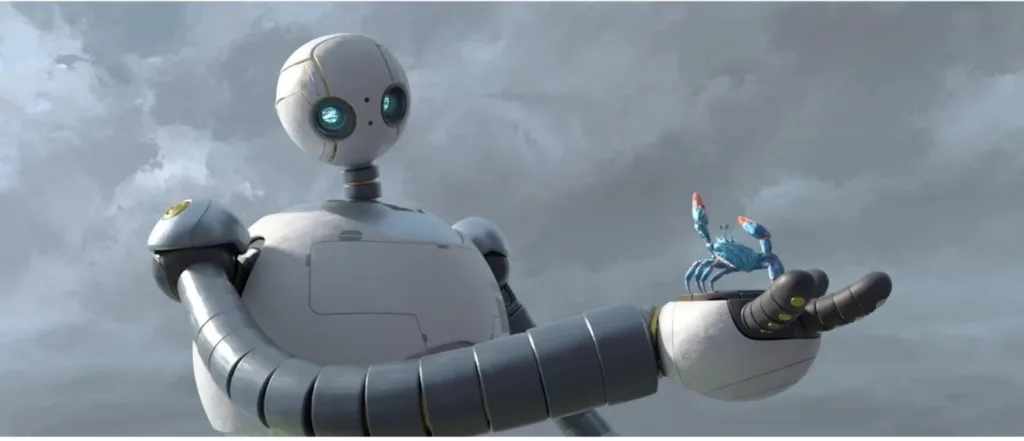
Jeff Budsberg, VFX supervisor on The Wild Robot at DreamWorks, described what the renderer enables directly: stylization coming out of the renderer itself, giving filmmakers the range to move between graphic novel aesthetics, painterly looks, and photorealism without being locked into a single visual language. Opening that capability to the broader industry means pipeline engineers and technical directors at other studios can now build on it, extend it, and return improvements to the codebase.
DreamWorks committed ongoing engineering resources to the project after the transfer. The ASWF provides the governance structure—intellectual property management, project lifecycle oversight, and the infrastructure that lets engineers from competing studios contribute to the same codebase without legal friction.
Open Source Days and what comes next
Bill Ballew, CTO of DreamWorks Animation, will keynote ASWF Open Source Days on July 19–20, 2026, in Los Angeles, immediately before Siggraph 2026. His talk—”How to Train Your Renderer: MoonRay’s Journey from DreamWorks’ Dragons to the ASWF”—covers the technical work required to extract a production renderer from a studio environment, the community-building strategy, and the reasoning behind choosing the ASWF as MoonRay’s new home.
The ASWF Call for Proposals for Open Source Days ran through May 24, 2026. Topics include pipeline tools, computer graphics, AI and machine learning in production, virtual production, cloud rendering, and interoperability—a list that reflects how broad the foundation’s scope has become since its formation in 2018.
MoonRay is available at openmoonray.org and through the ASWF GitHub organization.
The animation and VFX industry has spent the past decade converging on shared open standards—USD for scene description, OpenColorIO for color management, OpenVDB for volumetrics. MoonRay’s arrival at the ASWF adds a production-grade renderer to that foundation. Studios that previously couldn’t afford the engineering investment to build a path tracer now have one they can deploy, extend, and contribute to.
What do we think?
MoonRay is a serious production renderer with a verified track record across six feature films, and DreamWorks’ release of it under Apache 2.0 via the ASWF follows a pattern the industry has seen before. Pixar made a comparable move with RenderMan—originally a closely-guarded proprietary renderer that defined Pixar’s visual identity for decades before Pixar released a non-commercial free version in 2014 and eventually opened its source. The logic in both cases is the same: When a renderer reaches sufficient maturity and the external developer community grows large enough, shared development outpaces what any single studio’s engineering team can sustain internally.
There is also a competitive dimension worth acknowledging. DreamWorks’ contribution of MoonRay to the ASWF is both a generous and a strategic act. A production-grade Apache 2.0 path tracer with XPU support, distributed rendering, and a clean USD Hydra delegate raises the baseline for what the industry expects from open-source rendering. That raises costs for commercial renderer vendors—Chaos Group (V-Ray), Maxon (Redshift), Autodesk (Arnold)—that now compete against a tool with DreamWorks’ feature-film pedigree behind it, available at zero cost.
Which brings Blender into the picture. Blender’s Cycles renderer is already a capable open-source path tracer with a large developer community, GPU acceleration, and broad adoption outside of feature-film production. MoonRay targets a different tier—distributed rendering at feature-film scale, stylization directly out of the renderer, production-tested materials—but the two now occupy adjacent space in the open-source rendering landscape. Blender Foundation and the ASWF have historically operated in parallel rather than in coordination. Whether MoonRay’s arrival prompts closer collaboration, or simply adds a second credible open-source path tracer aimed at a higher production tier, is worth watching. For studios and pipeline engineers evaluating open-source rendering options, the choice just became more interesting.
Inflection signal
The motion-picture industry’s shift toward open-source production tools marks an inflection point in how studios build and maintain their technical infrastructure. For decades, rendering technology defined competitive differentiation—studios guarded their shaders, their lighting pipelines, and their renderers as trade secrets. MoonRay’s contribution to the ASWF continues the reversal of that posture. When DreamWorks concludes that open development of a renderer produces better outcomes than proprietary control, it signals that the inflection point has moved from rendering infrastructure to higher-level creative and pipeline tooling. The foundation layer is now a shared resource.
IF YOU LIKED WHAT YOU READ HERE, DON’T BE STINGY, SHARE IT WITH YOUR FRIENDS.