The Khronos 3D Formats Working Group has been busy on a new glTF specification, glTF 2.1, that extends glTF’s capabilities beyond holding a single asset to complex scenes. glTF 2.1 also includes
improvements that streamline the journey of an asset from authoring and format conversion, through asset management and optimization, to delivery and toolchain integration. While the specification is nearing completion, the opportunity is still open for community feedback.
The Khronos 3D Formats Working Group released glTF 2.0 nine years ago, and this open-standard 3D asset format continues to gain widespread industry adoption. The Working Group has big plans for the next release, glTF 2.1, with expanded core features that will provide robust support for complex scenes. The Khronos group says glTF 2.1 will be “a focused, backward-compatible revision of the core specification, built around a primary motivation—making glTF work as well for large, composed scenes as it already does for single assets.”
This major update will expand glTF’s support for use cases such as digital twins, building information modeling (BIM), smart cities, geospatial representation, simulation environments, progressive scene streaming, LOD hierarchies, and large-scale collaborative environments.
Today, applications using glTF typically turn to proprietary methods or custom tooling when working with complex scenes, limiting interoperability. This new release aims to eliminate those issues:
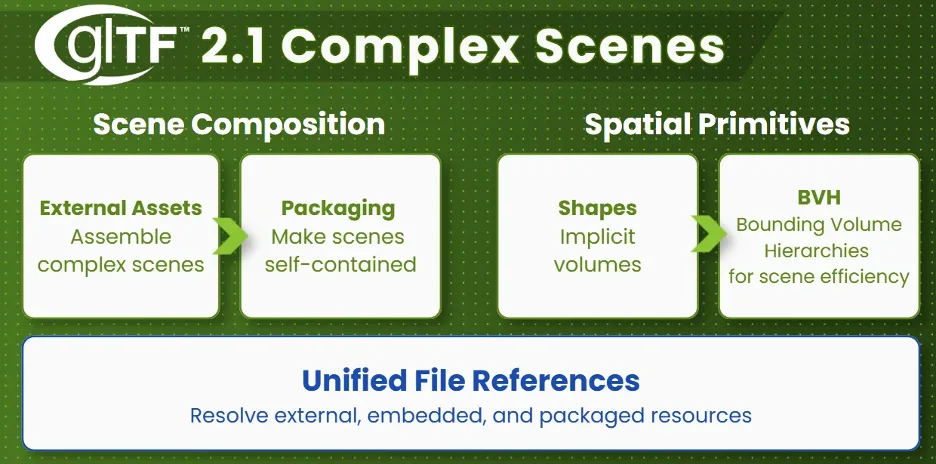
- External glTF/GLB assets can be referenced from scene nodes, instantiated once or many times at load time.
- Referenced assets can be packaged to deliver a composed scene and all its dependent resources as one portable artifact, without modifying the original files .
- Implicit shapes are supported including boxes, spheres, capsules, cylinders, and planes that can be used as compact bounds and proxies.
- Bounding volumes can be attached to any node, forming Bounding Volume Hierarchies (BVH) that make large scenes efficient to cull, stream, and query.
- Underlying all these capabilities, Unified File References enable naming, locating, and resolving external, embedded, and packaged resources, including glTF assets, textures, audio, behavior graphs, metadata schemas, and compressed payloads.
glTF 2.1 means that developers building large-scale scenes now have a standardized way to compose and deliver multi-file scene graphs. Also, applications needing 3D streaming can build on complex scenes as the foundation for progressive delivery, including spatial subdivision, availability maps, LOD, and quality metrics, and streaming hints already proven at scale by the glTF extensions forming the 3D Tiles standard developed by the Open Geospatial Consortium—now integrated into core glTF.
While the Khronos 3D Formats Working Group is focused on widening the spec’s scope, it has not turned its back on glTF’s core mission as a delivery format: the efficient, reliable transmission and loading of 3D assets at runtime. Rather, complex scenes extend what glTF can deliver—complete, composed, multi-asset experiences rather than just single models—without turning glTF into an authoring format. glTF 2.1 is complementary to content creation ecosystems such as OpenUSD, in that scenes authored and assembled in creation pipelines can be delivered as self-contained and interoperable glTF assets.
“This release has been guided by a clear philosophy: address the most impactful, widely needed improvements to the core spec while keeping glTF lean, interoperable, and backward-compatible,” said Amanda Morgan, Khronos 3D Formats co-chair and senior director, Open Standards at Bentley Systems.”Each feature has gone through a structured ‘Design First’ process: Working groups agreed on purpose, scope, behavior, and relationships before any schema work began, ensuring that every addition earns its place in the core.“
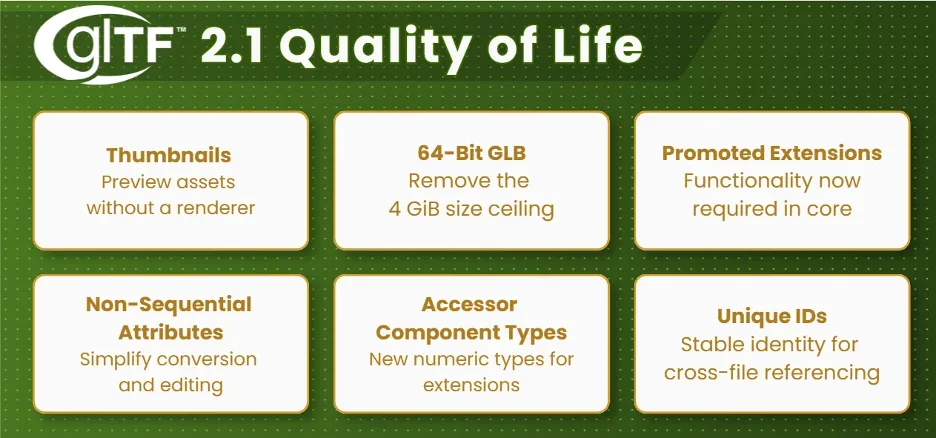
In addition, glTF 2.1 will deliver quality-of-life improvements, each yielding efficiencies in development and deployment pipelines:
- Asset creators and pipeline teams can include preview thumbnails directly in glTF files, making asset libraries browsable without a renderer.
- A 64-bit GLB format lifts the 4 GiB-size ceiling, and there’s a cleaner specification with the rarely-used multiple-scenes pattern formally deprecated.
- Lastly, widely adopted extensions are now in core glTF for wider availability, including WebP textures, a standardized node visibility toggle, and first-class Unique IDs (UIDs) directly support complex scenes and improve DCC workflows.
The glTF 2.1 specification is being developed openly on the glTF 2.1 GitHub; and community feedback is welcome as the specification is finalized.
Discussions will also be held at the seventh annual glTF Ecosystem Forum during Siggraph on July 23 from 2:00–7:00 pm, giving attendees the opportunity to share feedback and engage with the Working Group directly on the glTF 2.1 roadmap and the wider glTF ecosystem; space can be reserved here.
Ratification is anticipated in Q4 2026.
LIKE WHAT YOU’RE READING? INTRODUCE US TO YOUR FRIENDS AND COLLEAGUES.