Humans have always played because games let us experience life in a safe, rule-bound environment: solving problems, planning, making decisions under pressure, and exploring the unknown without real-world consequences. Games offer people a powerful mix of competence, autonomy, curiosity, and social connection, allowing players to improve, choose, discover, compete, and belong.
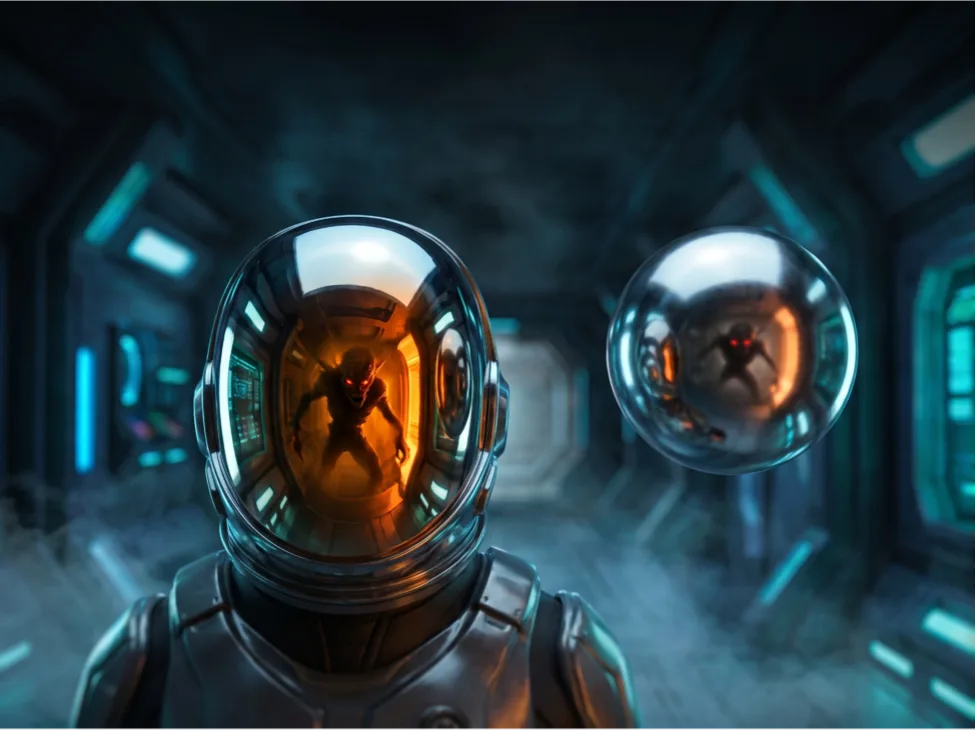
For decades, real-time rendering has treated reflections primarily as a visual-fidelity problem. Better reflections make metal look like metal, glass read as glass, and objects feel anchored in the same physical world. But for game design, that is only the beginning. When reflective surfaces update accurately, include dynamic and off-screen content, and remain affordable enough to run without disrupting frame time, they can become part of the play itself.
That is the proposition behind Real-time Raster Reflections (RTRR), a patented approach to generating real-time reflections on non-planar surfaces using a conventional raster graphics pipeline. Its most interesting promise is not simply photorealism at lower cost. It is the possibility of turning mirrors, helmets, car bodies, weapons, water droplets, and curved architecture into active interfaces between the player and the game world.