Executives digest a lot of content quickly, and rarely in one format. A museum visitor walks through an exhibit, absorbing images, artifacts, and text in sequence. A CEO or founder faces something harder: images, video, slide decks, documents, web pages, email, text messages, and audio recordings, all carrying status information that matters, often urgently. Existing tools fall short of that job. Content doesn’t always live in web-page form to begin with. Even when it does, a single web page limits how much variety a person can absorb at once, and jumping between pages or entire websites eats time and breaks concentration exactly when someone needs to move fast.
Remote access compounds the problem. A decision-maker working away from headquarters still has to navigate the same scattered mix of web pages and sites to reconstruct real-time status, and often needs input from a subject-matter expert before committing to a call. Stitching that together on the fly, across multiple browser tabs and applications, works against the speed the situation demands.
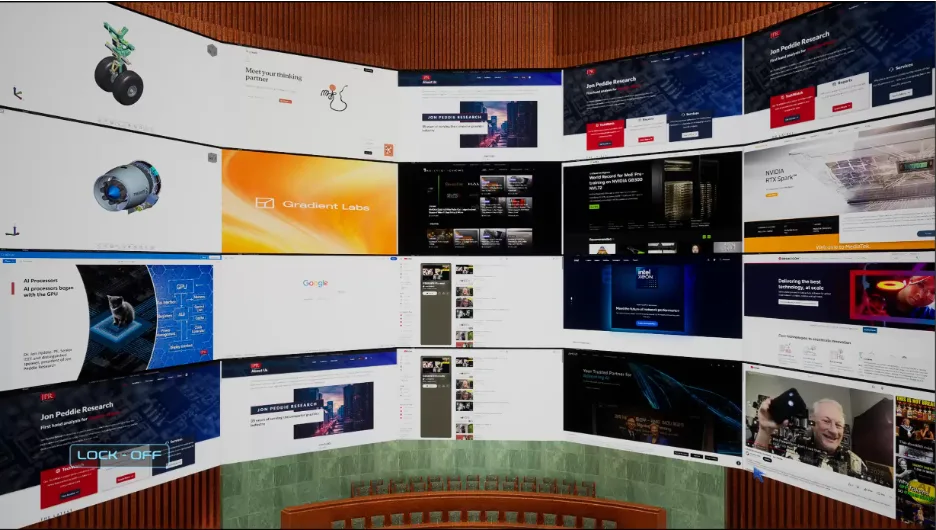
A new patent from AstroVirtual describes a different approach: build the situational-awareness center as a place, not a stack of browser tabs. The invention generates a fully-immersive, photorealistic 3D environment using real-time ray tracing, the same rendering technique modern game engines use, and arranges anywhere from four to more than 100 virtual 3D displays inside it. Each display can hold web-browser-derived content pulled in real time, images, video, slides, documents, live pages, whatever the situation calls for, assembled into what the filing calls a virtual collaborative 3D situational-awareness center or room.