Chaos shakes up rendering capabilities with some new features and capabilities in its V-Ray 7, update 4, which was released during Siggraph 2026.
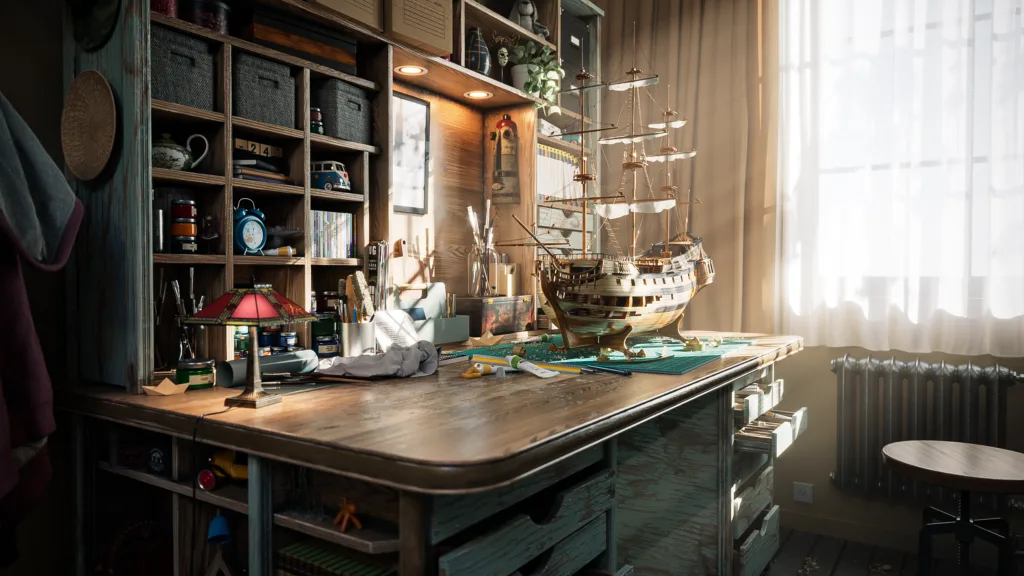
At Siggraph 2026, Chaos announced the availability of V-Ray 7, update 4, bringing new features and capabilities to artists. For one, real-time rendering with path-traced feedback is now available directly in almost every major DCC application’s viewport—without any tool switching, fewer conversions, and less rebuilding when working on a V-Ray scene.
“Artists lose time when a scene has to be converted or rebuilt when it moves between tools,” said Allan Poore, chief product officer at Chaos. “V-Ray 7, update 4 keeps the same asset moving from early exploration to on-set production and final rendering. That means faster feedback, fewer technical interruptions, and more time to focus on the shot.”
The workflow is available through a Vantage Hydra Delegate for Houdini and an enhanced Maya Live Link, with 3ds Max integration introduced earlier this year. Support for Blender is coming soon via Live Link; Chaos is also developing an OpenUSD Hydra Delegate to bring Vantage’s real-time and V-Ray’s offline rendering into other host applications, including Nuke and Katana.
The update also brings users the ability to relight fully ray-traced Gaussian splats, making it easier to blend scanned, real-world environments into 3D scenes. Since splats usually include baked-in lighting, matching the lighting to a 3D scene has been difficult to do in the past. Now, with Gaussian splat relighting, artists can adjust the lighting of captured environments in Houdini, Maya, 3ds Max, and Vantage (and coming soon to Blender) without re-creating the location or using complex workarounds.
Additionally, the release expands Chaos Arena’s real-time toolset for virtual production with new features such as real-time material editing, real-time depth of field, decal color corrections, and lens encoder support.
According to Chaos, V-Ray 7.4 also delivers faster CPU and GPU rendering—GPU interactive previews can now begin up to twice as fast, while CPU rendering is up to 13% faster on supported configurations.
V-Ray 7.4 is available now, extending across Maya, 3ds Max, Blender, and Houdini.
WHAT DO YOU THINK? LIKE THIS STORY? TELL YOUR FRIENDS, TELL US.