Apple just shipped its first 2 nm chip and paired it with the most powerful silicon the company has ever built. M6 lands in a refreshed Mac mini, combining all three of Apple’s core types on one die for the first time. M5 Ultra fuses four dies into a single quad-die processor inside the new Mac Studio, built specifically for people running large AI models entirely on their own desktop. We walk through the real specs behind both chips, what changed, and what stayed the same.
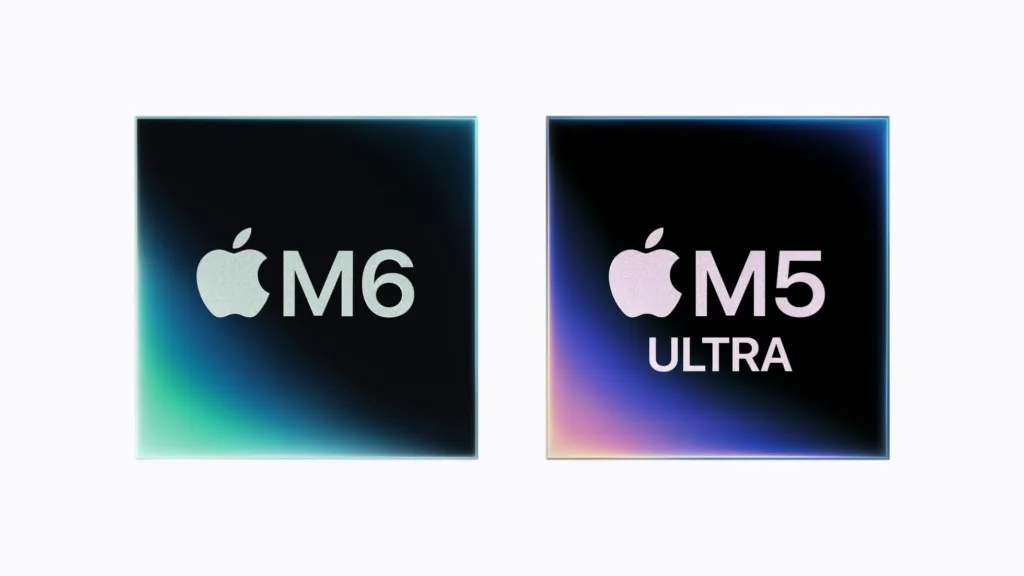
Apple’s new M6 processor moved to TSMC’s 2 nm process, the first Apple silicon built on that node, and it’s the first Apple chip to combine super cores, performance cores, and efficiency cores together on a single die. The 12-core CPU complex splits into two super cores, four performance cores, and six efficiency cores, two more cores total than M5.
Super cores themselves debuted earlier, on M5 Pro and M5 Max in March; M6 is the first chip to run all three tiers at once. Apple states the world’s fastest single-threaded performance from this configuration is up to 1.2× the multithreaded throughput of M5, and up to 2.4× faster performance than M1, the baseline Apple keeps returning to for long-arc comparisons across the M series. The super cores absorb single-threaded work directly, the performance cores join them for demanding multithreaded jobs at lower power draw, and the efficiency cores handle background tasks without pulling from the same power budget.
Apple names four workloads this configuration targets directly: editing images, compiling code, indexing new files, and running agentic AI workloads, all tasks that stress a mix of single-threaded responsiveness and sustained multithreaded throughput at once.