DCC tool vendors are exploring the use of Model Context Protocol (MCP), with SideFX among them, adding support in Houdini 22. Currently, this is early preview and heading to Houdini Labs, and the tech is not in the core product, yet. At a SideFX keynote show-and-tell, the company highlighted its progress in this direction, as AI assistants use a curated library of Apex Script syntax and examples to help artists write procedural character-rigging code.

Artificial intelligence is fast becoming “the insider” in the M&E world. In the past, it has been an outsider, operating as a set of stand-alone generative tools sitting outside the software pipelines used by artists. That is starting to change, as AI agents shift to living and working within, not outside of, DCC applications.
The nexus for this change? The Model Context Protocol (MCP), an open standard that lets an AI assistant connect to an application’s own commands, documentation, and data. One of the software companies working toward AI integration is SideFX within Houdini. Others include Adobe Firefly, Express and Creative Cloud, Affinity by Canva, Blender, Boris FX Silhouette, Foundry Griptape, and Epic Games Unreal Engine.
MCP-connected tools mark the fourth phase of DCC applications evolution:
- Phase 1: CPU software rendering & manual scripting
- Phase 2: GPU acceleration, CUDA solvers & hardware ray tracing
- Phase 3: Neural denoising, machine learning & real-time viewports
- Phase 4: Agentic AI & MCP integration (context-aware action execution)
When AI is mentioned, some artists look at it side-eyed, fearing the loss of their creative control. Nevertheless, artists have been developing a love-hate relationship with AI, enjoying the advantages it offers them, all the while tamping down fears and remaining cautious. MCP changes that thinking, giving an agent access to the tool an artist already uses, then asking it to handle the parts of the job that are tedious rather than creative, or supporting ideation in early stages of the workflow or artistic what-if scenarios.
“The inclusion of MCP-connected tools to industry-standard 3D, video, and VFX applications gives artists the control and productivity they want, creating a human+AI dynamic that turns power users into super users!” –Hernan Quijano, Workstation Analyst, JPR
That framing matters across nearly every MCP integration announced at Siggraph this year.
- Productivity: Agents can execute multistep production tasks in seconds rather than manual passes.
- Easier access to documentation: An artist can ask a natural-language question and get an answer grounded in the actual application programming interface (API) rather than a general-purpose model’s guesswork.
- Faster prototyping: Agents can generate a first pass at code, a rig, or a scene setup that an artist then refines, rather than starting from a blank graph or scene.
A deeper look into SideFX’s adoption
At the Houdini 22 keynote from London on June 22, Cristin Barghiel, SideFX VP of product, introduced AI as one of two “groundbreaking technologies” for Houdini 22, alongside 3D Gaussian splatting, describing a hybrid pipeline in which Houdini’s procedural tools coexist with homegrown machine learning and third-party models such as Detectron, SAM, and MoGe.
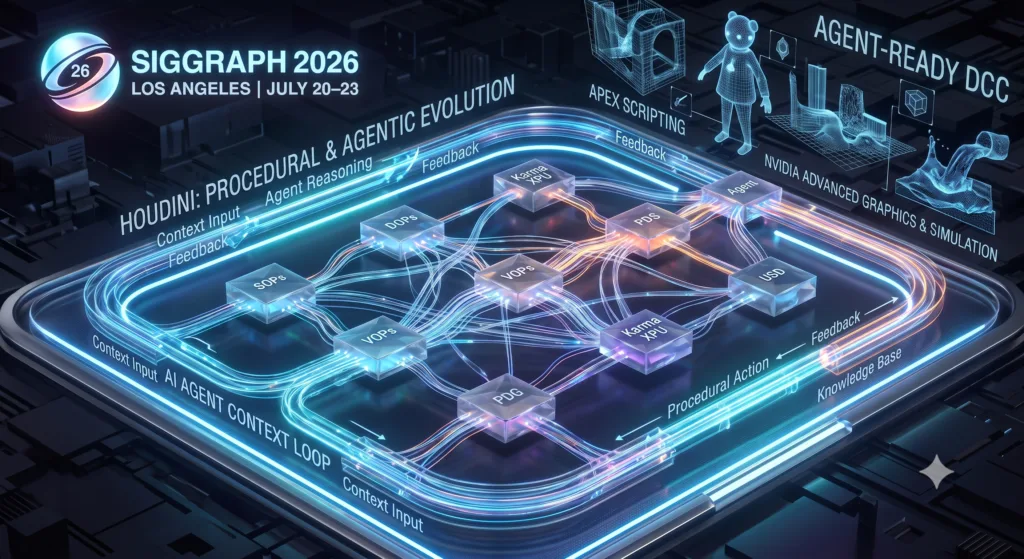
MCP-connected tools are the next obvious step to SideFX Houdini GPU-acclerated features. (Source: JPR)
Houdini 22 gets MCP support through what the company calls the Apex Script Comfort Package. Apex is Houdini’s procedural rigging and animation system, and Apex Script is the code layer underneath it. The package gives AI assistants a curated collection of Apex Script syntax, functions, documentation, and examples aimed squarely at one job: helping artists generate and refine procedural character-rigging code.
The Apex Script Comfort Package bundles a Visual Studio Code extension for autocomplete, a Python panel inside Houdini, and an Apex Script MCP server. The server connects a large language model to a token-efficient library covering syntax, style guidelines, and code snippets, and it ships with a validator that checks generated code before it runs.
In the Houdini 22 keynote demo, an artist typed requests such as building six S-shaped splines or looking up how to implement a look-at function, and the assistant returned working Apex Script pulled from real examples rather than invented syntax. SideFX said the result, in one case more than 300 lines of a functional rig component, carries no ongoing dependency on the LLM once generated. The artist owns a plain script, not a black box.
SideFX introduced the Apex Script Comfort Package on stage as a “sneak peek,” adding that users would potentially find it later in Labs, SideFX’s channel for experimental, pre-production tools. It’s worth noting, though, that community-developed MCP servers already offer broader, if less officially supported, ways for agents to interact with Houdini outside the Apex Script scope.
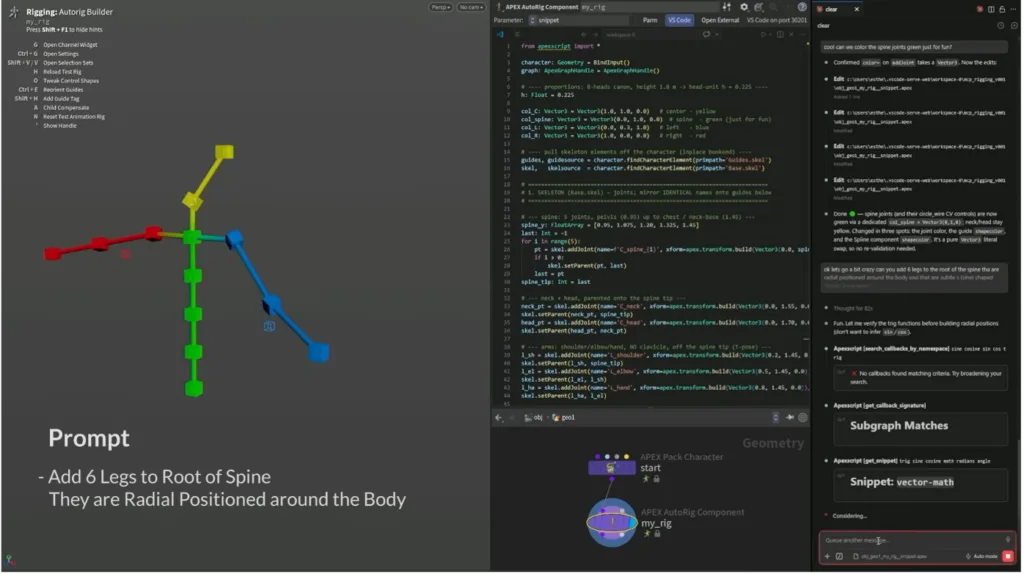
MCP connected to Houdini to rig a character with Apex. (Source: SideFX keynote)
As of now, the discussion for Houdini’s and MCP has been on rigging, but other possibilities ripe for the tech, in this writer’s opinion, include simulation setup and Solaris and USD scene assembly.
In principle, an Apex Script MCP workflow should run on any workstation capable of hosting or connecting to a large language model, regardless of whose GPU is being used. However, given the GPU-vendor sensitivity of some Houdini 22 features (Karma XPU, Vulkan-based viewport) Nvidia has done its early work to enable its GPUs for all Houdini-accelerated and AI-based tools.
It’s clear Nvidia is supportive of the MCP-tool integration, discussing this growing trend at Siggraph 2026 and its technology that’s available to assist users. Nvidia’s messaging positions its own RTX Pro, DGX Spark, and DGX Station hardware as accelerating local AI agents and inference generally, not as a requirement specific to Houdini’s MCP server. Having a capable deskside system brings AI performance closer to artists without sending data to external services.
In summary,MCP in Houdini 22 is real, narrow, and still a preview, and targets Apex Script code for character rigging in a way that keeps the artist in control of the output. That is a sensible, conservative first step for a procedural tool in which trust in generated code matters as much as speed. The big question is, when will it move out of Labs and into product? And by the same token, when will it stretch into simulation, lookdev, and scene assembly?
—The Workstation Cavalry
AND IF YOU LIKED WHAT YOU READ HERE, DON’T BE STINGY, SHARE IT WITH YOUR FRIENDS.
Disclaimer: This article is not financial advice. The content is for informational purposes only. The author may own shares in companies mentioned, and readers should not consider this article a recommendation to buy, sell, or hold any assets.