Jon Peddie Research has unveiled its 1H 2026 PC Gaming Hardware model, and for the first time in over 20 years tracking PC gaming hardware, JPR found that select integrated processor-based PCs (also called system on a chip, or SoC) now rank alongside some mid-range gaming PCs that use dedicated graphics cards.
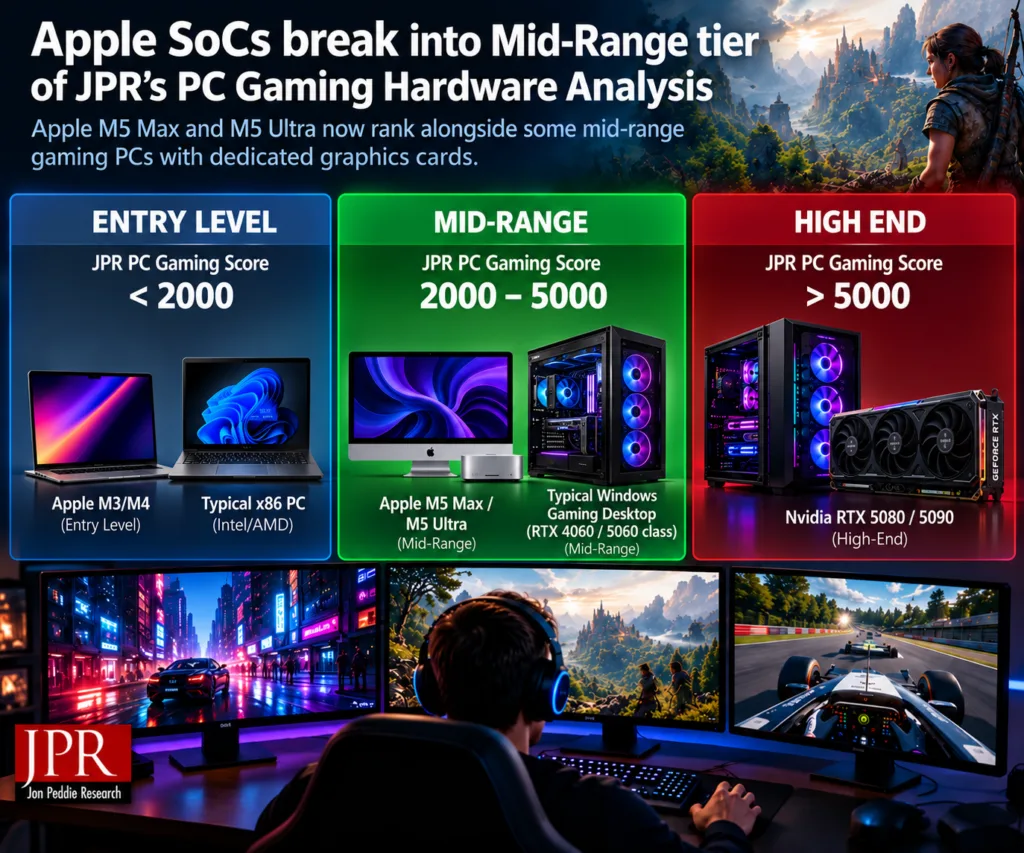
Specifically, Apple M5 Max- and M5 Ultra-based systems have exceeded JPR’s Mid-Range compute threshold. Comparing SoC PCs to discrete GPU/CPU PCs is a difficult challenge and required JPR to come up with a scoring formula currently based on GPU FP32 teraflops, general memory bandwidth, and estimates of GPU vs. CPU/GPU-bound game engine code averages across PC games. JPR also took into account the increased probability of thermal throttling on an SoC, the compute power lost to Windows emulators on Arm architecture, and the dedicated VRAM advantage of discrete GPUs. Adding a penalty to the SoC PC’s score based on these weaknesses and setting a threshold using the lowest-ranked discrete processor combos in JPR’s Mid-Range tier allowed these Apple PCs to achieve this historic milestone.
Because Apple PCs have a lower probability of being used as gaming PCs, the market model had to be adjusted, reducing what JPR calls the “Gaming Influence Factor,” which acknowledges the average gaming purchase intent of a PC customer. While many Windows PCs are bought and built for PC gaming, Apple PCs rarely are, and this is accounted for in the market model. JPR expects Intel and AMD x86 SoCs to surpass this Mid-Range threshold in 2027. All Arm architecture chipmakers, including Apple, Qualcomm, and MediaTek, are already included in JPR’s Entry-Level PC Gaming category. Only Apple has achieved Mid-Range designation with the M5 Max and Ultra.
Ted Pollak, author of the model and senior analyst, commented on general conditions: “The global PC gaming hardware market is shaping up to be almost stagnant in 2026 vs. 2025, at around $56 billion of economic activity. This is due to two factors. The first is that people are still holding back on discretionary spending, which caused the refresh rate to slow. Simply put, gamers are waiting longer to upgrade. This could be a blessing in disguise, because the second market condition is that current hardware prices are very high due to AI data center demand. We forecast gamer pent-up demand being satisfied with large market jumps in 2027–2029 dovetailing with lower component pricing. AAA 1440p-optimized x86 SoC PCs will also come further into the picture, enticing console defectors and new entrants into the market.”
JPR’s PC Gaming Hardware Market Study offers an advanced financial modeling of the global PC gaming hardware market. The study is available as a single report or as a subscription, comprises two issuances per year, and includes a one-year history, a current-year estimate, a three-year forecast, and eight hours of consulting.
WHAT DO YOU THINK? LIKE THIS STORY? TELL YOUR FRIENDS, TELL US.