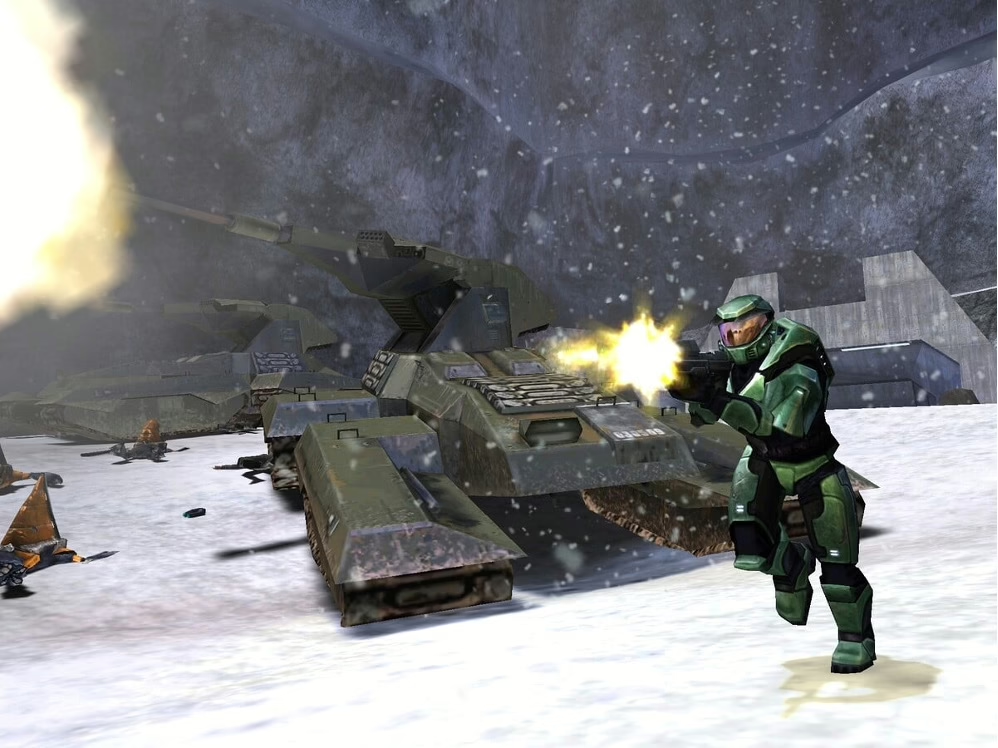
In Part I of this story, we follow the precarious journey of Microsoft’s Xbox, as it eventually won an internal struggle that led Microsoft to place a heavy bet on this game machine. Bungie also bet the farm, or rather, the future of Halo and Master Chief, on the Xbox’s success, when the game developer turned away from Apple and the Mac platform and was acquired by Microsoft, becoming part of Microsoft’s big bet on Xbox, which we chronicle here in Part II.
Part II
Time was running out, and both Microsoft and Bungie were under pressure to prepare picture-perfect products. There was this mad scramble to get both Xbox and Halo fully functioning by their fated launch date: November 15, 2001. For Xbox, the sailing was anything but smooth. The console case went through design purgatory, with one iteration being a giant metal X with the hardware stuffed haphazardly inside. Edges of the motherboard had to be shaved down so everything could fit. This would be the model that Seamus Blackley, Microsoft program manager, would use to demo at the Game Developers Conference on March 20, 2000 (a model that Blackley had to solder back together after it, along with the other two backups they had brought, had failed to boot up before the presentation).
The final design would be boxier, while keeping the X shape molded into the case, and an eye-grabbing green circle in the center. There were also criticisms with the controller. Nicknamed “the Duke,” it was comically colossal for a console controller. It was very much made for users with larger hands. By that point, however, there was no turning back on the design. A newer, slimmer model known as “Controller S” would ship in 2002 in response to the criticism.
The Xbox was equipped with a plethora of custom hardware, including an Intel Pentium 3 CPU (clocked at 733 MHz), an Nvidia NV2A GeForce 3 (clocked at 233 MHz), 64 MB of SDRAM, and 8–10 GB of HDD storage. Of these components, the NV2A is what brought the graphical fidelity Microsoft needed to compete with the PlayStation 2’s Emotion Engine. Built with four pixel-pipelines, eight texture mapping units (TMUs), two VPUs, and four Render Output Units (ROPs), the NV2A was a rendering powerhouse. This allowed the Xbox to perform at an astounding 932 million pixels per second, 1.86 Gtexel per second, and 20 GFLOPS. With all of these specs, real-time lighting and rendering worked in tandem with bump mapping and shaders to bring Xbox’s graphics to the clarity required to compete with PS2’s Emotion Engine. Microsoft was ready to go on the offense.