Foundry has acquired Griptape, a Seattle start-up founded in 2023 by former AWS veterans. Griptape offers an enterprise-grade AI orchestration platform. With Griptape, users access AI models and agents through the creative tools they are already using daily. Griptape’s open-source Python framework features a node-based visual interface, making it easy for artists to use.
Foundry has a rich history as a tool maker in the M&E industry, and now it believes it has found gold with its acquisition of Griptape, whose technology makes it easier for users to take advantage of AI capabilities in their workflows.
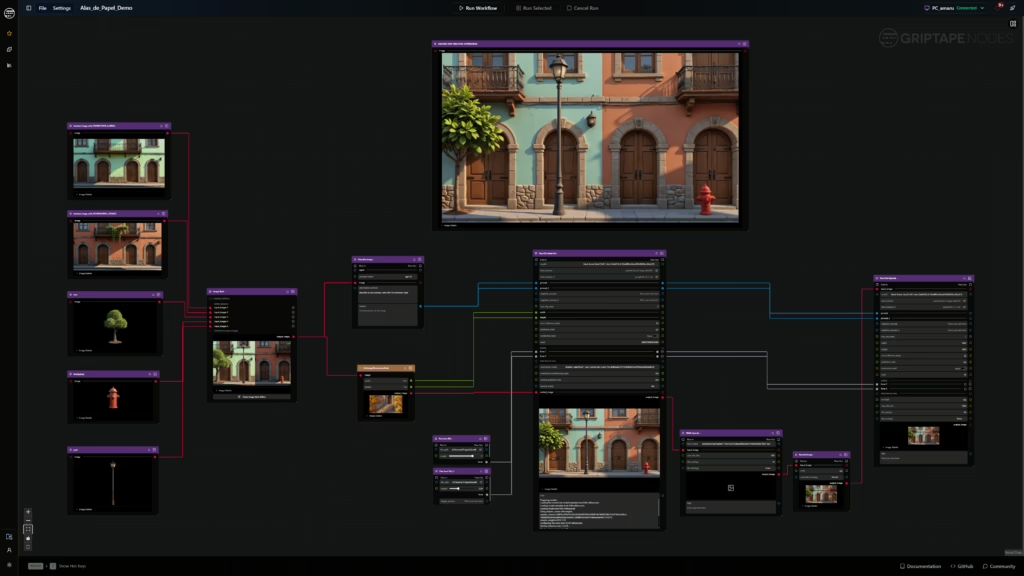
Griptape simplifies and coordinates the process of managing multiple AI models and automated tasks so they work together in a reliable, repeatable sequence, all within workflows that connect seamlessly with creative tools users are already using and familiar with. Consider, for instance, a multi-step VFX process whereby a segmentation model identifies characters in a shot, an image gen model is used to generate a background, and then a Python script sends the outputs of those steps to Nuke for compositing, Griptape acts as the glue that ensures the steps “talk” to one another and that the data reaches the artist’s DCC tool.
Griptape’s Python-based architecture enables seamless integration with existing production infrastructure including render farms and management systems. While Foundry says it is planning to build strong integrations with its tools, especially Nuke, developers can easily integrate it with other tools from other companies.
By integrating Griptape with DCC packages, artists can more efficiently leverage AI models and complex setups of multiple models within their creative context, managing those workflows without leaving the DCC software. So rather than switching between disconnected tools, artists access the AI capabilities directly through their regular toolsets.
As studios shift from experimentation to everyday production use, the need for better control of AI models has become critical, Foundry says. Griptape’s orchestration replaces ad-hoc tool switching, enabling artists to build custom AI pipelines using drag-and-drop nodes, negating the need for them to possess extensive technical expertise. This reduces manual steps, increases consistency, and accelerates delivery times, says Foundry, while enabling artists to maintain creative control over the process. Moreover, it enables controlled access to rapidly evolving open-source and commercial AI models in a user-friendly framework, while maintaining the strict security and traceability required by major production environments.
Griptape includes the following offerings:
- Griptape Nodes—An intuitive, drag-and-drop visual interface for creating advanced creative pipelines using graphs, nodes, and flowcharts.
- Griptape AI Framework—A modular, open-source Python framework that enables developers to build and deploy LLM-powered applications with primitives such as agents, pipelines, and workflows.
- AI Cloud—All the pieces needed to build, deploy, and operate LLM-powered applications, integrated with the user’s own data, in the cloud.
- Griptape Local—The capabilities needed to quickly and easily design, build, deploy, and operate LLM-powered applications on the studio’s own infrastructure.
According to Foundry, this acquisition accelerates its AI strategy by adding critical arrangement capabilities to complement the AI-powered features in its product portfolio.
“We’ve been investing in AI and ML capabilities for years, and many of our customers are already using AI-powered features daily. We are building the AI-first pipeline of the future—and Griptape is a critical piece of that foundation to accelerate our roadmap,” says Foundry CEO Jody Madden.
In 2021, Foundry introduced a new machine learning framework in Nuke 13 and released CopyCat, which allows artists to train their neural networks for whatever effect they need for their shot or sequence.
Griptape is built as an open, model-agnostic framework that integrates across industry pipelines. It supports Model Context Protocol (MCP), an open standard and open-source framework standardizing the way artificial intelligence systems like large language models integrate and share data with external tools, systems, and data sources, thereby enabling connection with tools like Autodesk Maya and Blender, alongside Foundry Nuke. Foundry says it will continue that agnosticism as it further develops the offering.
LIKE WHAT YOU SAW HERE? SHARE THE EXPERIENCE, TELL YOUR FRIENDS.