AI created a lot of mixed emotions in the content creation/production industry last year: The Ultimate Samuri, protecting/preserving/improving the industry, or The Four Horsemen of the Apocalypse, laying waste to everything. But it was the business shift that set the stage for the uncertainty of change that we’ll experience in the next two years.
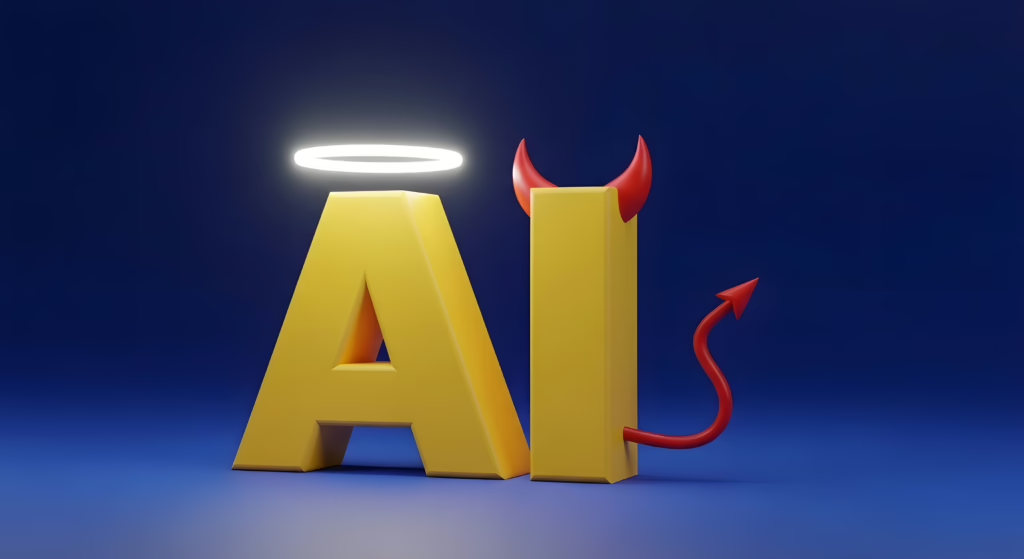
The business of the business has been fundamentally changed, and AI is a tool that will facilitate how the industry – creation/production/postproduction/distribution – will look like tomorrow.
We’re in the process of losing another major studio (WB), and we’ll assume that because of David Zaslav’s (CEO of WBD) bromance with Ted Sarandos (co-CEO of Netflix), WBD will be absorbed by Netflix with their respectable bid of $83B. In addition, he has made a commitment to keep movie windows even though their very successful business model is all about churning out films/shows/stuff that keeps subscribers happy.
We believe Sarandos meant what he said, but he didn’t bother saying how long those theatrical windows will be, since consumers have been trained to expect short windows.
Even though record crowds flocked to theaters to see the finale of Stranger Things, it probably won’t be enough to convince Netflix that keeping new films in theaters for a reasonable period of time is a wise move rather than “an outmoded idea.”
The shift in content consumption preferences doesn’t exactly shift the scale for theatrical window, and a rebound to box-office records is extremely unlikely. According to a recent study, 75 percent of US adults streamed a recent release this past year, while 16 percent watched them in cinemas, and there’s a high cost of marketing a theatrical film to persuade people to put seats in seats ($100,000–$10M).
Despite the viewing-taste shift, major producers/directors/actors/production teams are making the case for a strong movie-house project schedule and presence. Typical of that was Leonardo DiCaprio’s recent award acceptance speech for One Battle After Another, when hesaid original films are harder to make but movies still matter and the stories are meant to be shared by people in a dark room in a communal experience. And he’s joined in advancing the message with major influentials in the US and around the globe.
A modest schedule of tentpole, sequel, spin-off and franchise (expensive) films will continue to be shown first in theaters to recover costs and raise viewer interest/anticipation. But the path forward for medium/low-budget and “different” projects and shows will be greenlighted/controlled/managed by the subscription and ad-supported streamers.
A good bellwether of this has been YouTube’s rise to the singular, dominant entertainment platform that offers a range of content genre, appeal and duration to satisfy the constantly shifting viewer binge, one-off tastes – long form (2–3 hours), medium form (30–60 minutes) and short form/microdrama (3–10 minutes). To tap into this new content-hungry market, Substack, Instagram, TikTok, Crunchroll, Tubi, ReelShort, Pluto TV and others have become viewer and indie creative/creator destinations. Suddenly, the focus has shifted from stories creative professionals want to deliver to what folks want to consume their way. One of the best/worst examples of this is Jimmy Donaldson’s multibillion-dollar Mr. Beast empire – no agents, no studio heads and minimal production teams. To survive, thrive studios, networks, producers, writers, directors, actors, production and postproduction professionals are forced to adapt or ….
While all of this has been going on, studio and service executives have been condemning/fighting/acquiring AI. Disney, Universal and Warner Bros. sued Midjourney over training their libraries with unauthorized copies of content. Despite that, Disney invested $1B in OpenAI’s Sora, while Amazon, Apple and Netflix have made heavy investments in AI content recommendations, production, and measurement tools to lower their costs and increase their content volumes/varieties/formats.
It clearly puts synthetic projects on the table in our attention-driven future. A good indication of this shift was the fact that about 17,000 jobs disappeared as the industry transformed in real time. Automation has made the size of the labor pool less relevant, and executives have reduced their willingness to take project risks. Instead, they’re relying on “proven” viewer data to greenlight projects.
Movie and TV production left California for other states/countries because of more desirable production costs and salaries in other areas. The industry has faced technological shifts before, but the new wave of technologies is different as streaming sparked something we hadn’t encountered before – encouraging viewers to expect an all-you-can-consume smorgasbord of online entertainment.
This seemingly insatiable demand has also totally revised creation/production team contracts.
According to the recent University of York report, Screenwriters’ Earnings in the Video Streaming Age, residuals and future payments are a thing of the past. Buyout contracts, including worldwide exclusive rights, are now de rigueur. We’re frankly sick and tired of the AI leaders saying, “You won’t lose your job to AI – you’ll lose it to someone using AI.” Everywhere we turn, it’s AI inside/enabled, and we’re reached the point where it means everything/nothing.
Just as with yesterday’s software maturation, it’s the strength/robustness of the tools and the talent of the individuals using them.
Right now, a good percentage of the output is AI slop that is tested on people hundreds of different ways/different times to determine what – if anything – resonates, clicks with the viewers. There are some excellent AI-enabled tools that are available today, such as Adobe Premiere, DaVinci Resolve, Canva, Runway and others. In the right professional hands, they can create, develop, produce and deliver films, shows and shorts that can capture and retain viewer attention as long as the basic story concept/storyline delivers a strong, consistent, organized viewer message.
With today’s AI creative tools, any idiot can make a movie – regardless of length – but only people who know how to create and tell an interesting/enthralling story people will be willing to invest their time/money in watching.
Despite what Meta’s Zuckerberg, OpenAI’s Altman and even Nvidia’s Huang say about what AI can do, what folks believe it can do and what it can really do; there’s a helluva chasm. Left to create on its own, AI can’t/won’t deliver movies, shows, content that puts seats in seats in theaters, homes, on the go. It will democratize and expedite the way professionals do simple edits and final post work, freeing them to focus on the critical points/issues that separate good films/shows from consistently great work. While those who relax and place their faith/reputation in the promises that AI can/will do it all will….
AI is here to stay and won’t fade into oblivion, no matter how much you might like it to, but it will reduce the number of people in your creative/production team while speeding/improving workflow. The optimist in us says that the disruptions will mean more and better-quality work for those who can adopt and adapt.
Will Hollywood return to its glory days as the absolute center of the film/show creation/production? Probably not!
A Warning Note – The global demand for all things AI has also had a very negative impact on the hardware tools creatives need. You are constantly upgrading and building out your systems on a regular basis. AI’s demand for bigger, better, faster, more powerful storage solutions has forced system/storage manufacturers to shift from “normal” devices to meet the hardware/storage requirements that a $5,000 AI GPU-loaded data center demands. Second- and third-tier folks are rushing to fill the void with “good enough” and questionable systems, solutions, devices. Stick with firms that have a strong reputation/track record in the industry, even when the prices may be slightly higher and delivery times more than you would like. Your work is too important to lose.
LIKE WHAT YOU’RE READING? INTRODUCE US TO YOUR FRIENDS AND COLLEAGUES.