HP showed up at CES 2026 with a new twist on an old concept—a full Windows PC inside a keyboard. The EliteBoard G1a runs modern Ryzen AI processors, powers dual 4K displays, and is easily transported inside a backpack.
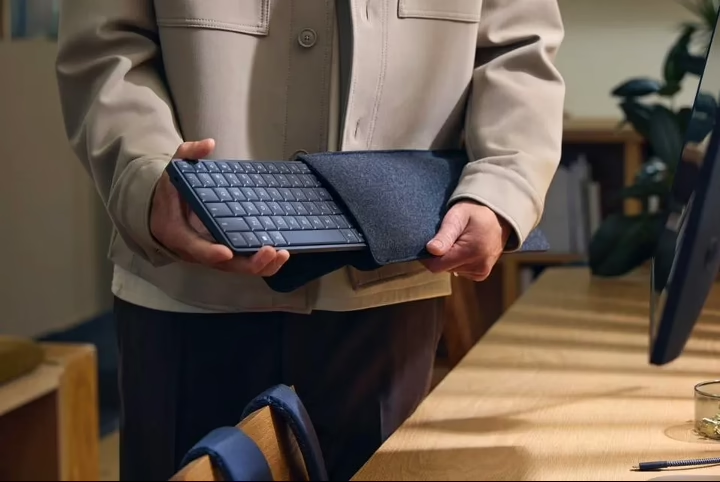
What’s old is often new again. And HP illustrated this at CES 2026, reintroducing a decades-old concept: a full Windows PC built directly into a desktop keyboard. Businesses have been relying on laptops for hybrid work, and the Copilot+-class system EliteBoard G1a can fill that need.
The EliteBoard’s design hides its hardware behind a familiar layout. The chassis looks like a standard office keyboard with 2 mm key travel, a number pad, and a low profile, but the underside carries vents, ports, and in some configurations, a built-in USB-C cable. The device connects to a monitor through USB-C, drawing power and sending video over the same link when the display supports it. If the display lacks USB-C, an included USB-C–to-HDMI adapter bridges the gap, although that configuration requires a separate 65 W USB-C power brick. HP expects most users to rely on a wireless mouse, which keeps the desk uncluttered and aligns with the EliteBoard’s intended workflow.
Inside the chassis, HP integrates AMD’s Ryzen AI 300-series processors, ranging from Ryzen AI 5 to Ryzen AI 7 variants. These chips combine Zen-based CPU cores, integrated Radeon 800-series graphics, and an NPU capable of up to 50 TOPS. The design meets Microsoft’s Copilot+ requirements, enabling on-device recall, AI-assisted workflows, and Windows Studio features without cloud dependency. System memory scales to 64 GB of DDR5-5600, and storage reaches 2 TB of NVMe SSD capacity. Wireless options include Wi-Fi 6E and Wi-Fi 7.