Adobe likes to whet our appetites for their new offerings and capabilities, introducing them and offering them first in private beta, then public beta, and, finally, in general availability. Hungry users often do not have to wait long for the progression, as Adobe serves up the offerings fairly fast. Following the launch of the new Firefly as an all-in-one home for creative tools and AI models, Adobe has been advancing new partner models, a Custom Model, a conversational, agentic interface (Project Moonlight), and a new Image Model (Image Model 5) to support that new Firefly direction.
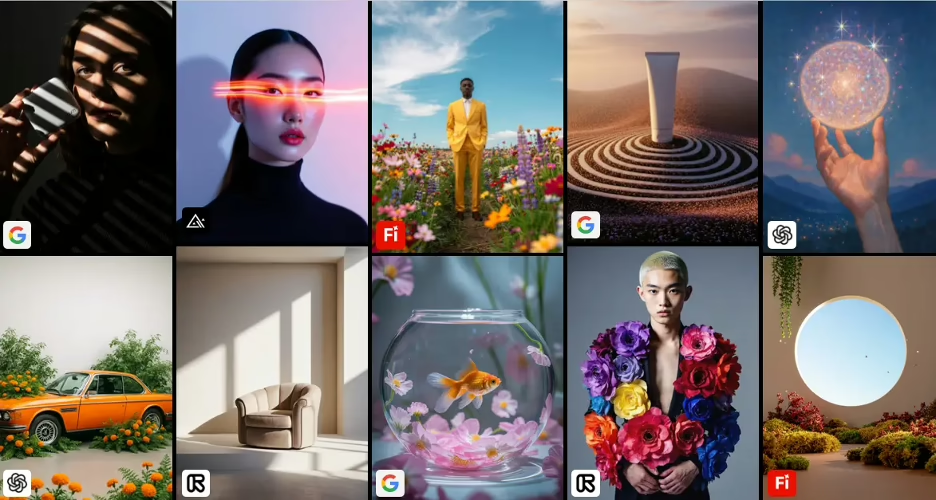
When Adobe introduced Firefly, which went into public beta in March 2023, it kicked off creators’ journeys into AI-assisted tools and workflows. Since then, Adobe has continued to add more, better, and stronger AI capabilities, turning Firefly into something much more than an AI app. It has become the creator’s all-in-one AI studio, and Adobe says that is no accident, that Firefly was always built to live up to billing.
Firefly has been spreading its wings for some time now, resulting in the emergence of an all-new Firefly that launched at Max 2025, becoming an all-in-one home for top AI models (whether for imaging, video, sound, and more) in one subscription. It’s also the one-stop location for ideation, creation, and production, enabling users to take a project from concepting to completion without leaving Firefly.
By making Firefly a single home, Adobe is eliminating the confusion that occurs when users have to jump from site to use the various models and tools; it also eliminates a multitude of subscription fees, thanks to the growing number of partners Adobe has teamed up with. Firefly’s list of supported industry models has now reached 30, including new additions such as Kling.
Adobe has continued its GenAI expansion, most recently extending access to Firefly Custom Models, now in public beta, so users can create their own unique models trained on their personal images. Creatives simply upload their branded assets, and Firefly analyzes and trains a model that’s aligned to that aesthetic, capturing the style, character, or photographic look. The Custom Models preserve details like stroke weight, color palettes, lighting, and character features across generations, Adobe says, enabling exploration of new creative directions without losing visual consistency.
So, rather than starting from scratch each time a new project is initiated, the trained model becomes a reusable foundation that the user can build on time and again.
Previewed at Adobe Max 2025, Project Moonlight is seeing more daylight, as Adobe announced that it is expanding access to the Project Moonlight private beta. Project Moonlight is a conversational, agentic interface that works across Adobe apps to assist users. It understands a person’s own style by drawing insight from a person’s assets and libraries, helping them to brainstorm new ideas and generate content faster. Adobe describes it as a tool that lets the user become the creative director of their own world, guiding the direction while the system helps carry the work forward.
Adobe teased this interface at Adobe Max last October, and a few days ago the release transitioned into public beta.
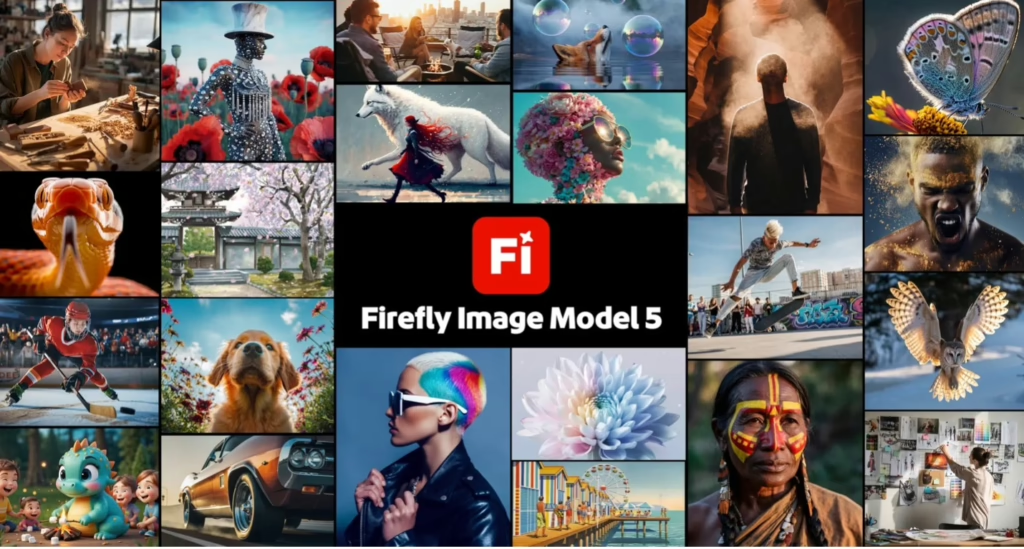
And, finally, Firefly Image Model 5 has become generally available, Adobe’s most advanced image generation and editing model to date. Image Model 5 excels at generating photorealistic details, Adobe says, capturing lighting and texture, creating lifelike portraits of people with anatomic accuracy, generating complex, multi-layered compositions, and producing natural movement. It can generate images in native 4MP resolution without upscaling and produce sharp, detailed assets. Additionally, with Image Model 5, users can edit images with just a prompt.
LIKE WHAT YOU’RE READING? INTRODUCE US TO YOUR FRIENDS AND COLLEAGUES.